CVIAggregator: Combining CVIs
Here is an example using exclusively PyCVI’s pycvi.cvi.CVIAggregator in order to guess the number of clusters in a dataset. The preprocessing steps and the clustering steps can be integrated into the PyCVI pipeline by providing sklearn-like classes of clustering models (e.g. KMeans) and data preprocessor (e.g. StandardScaler).
In this example, we use non-time-series data, but the syntax would be the same for time-series data.
Here we assume that we are in real conditions, which means that we don’t have access to the true labels (except that we plot the true data for illustrative purposes). We then don’t use the features included in the pycvi.vi module.
This example showcases 2 successful clusterings and clustering selections.
If you wish to run the example scripts on your own computer, please first follow the instructions detailed in Running example scripts on your computer.
  1
  2import numpy as np
  3import time
  4from sklearn.cluster import AgglomerativeClustering, KMeans
  5from sklearn.preprocessing import StandardScaler
  6
  7from pycvi.cluster import generate_all_clusterings, get_clustering
  8from pycvi.cvi import (
  9    CVIAggregator, CalinskiHarabasz, GapStatistic, Silhouette, Dunn, XB,
 10)
 11from pycvi.compute_scores import compute_all_scores
 12from pycvi.datasets.benchmark import load_data
 13from pycvi.exceptions import SelectionError
 14
 15from pycvi_examples_utils import plot_aggregator
 16
 17def pipeline(
 18    cvi_aggregator,
 19    X: np.ndarray,
 20    y: np.ndarray,
 21    model_class,
 22    model_kw: dict,
 23    fig_title: str = "",
 24    fig_name: str = "",
 25    k_max: int = 25,
 26    scaler = StandardScaler(),
 27) -> None:
 28    """
 29    This function gives an example of typical use of CVIAggregator.
 30
 31    In this example we assume that we are in real conditions, which
 32    means that we don't have access to the true labels (except for the
 33    final figure). We then don't use the features included in the
 34    :mod:`pycvi.vi` module. In this function we:
 35
 36    - Standardize the data
 37    - Generate all clusterings for a given range of number of clusters.
 38    - Define a CVIAggregator that will use all CVI available in PyCVI.
 39    - Compute CVI values using CVIAggregator
 40    - Select the best clustering according the CVIAggregator, itself
 41    - selecting the best clustering according to a majority vote on the
 42      best clustering according to its individual CVI.
 43    - Create a summary plot containing the true clustering, the selected
 44      clustering according to the CVIAggregator and the votes of the
 45      individual CVIs represented by the CVIAggregator.
 46    """
 47    print(f'\n ***** {fig_title} ***** \n')
 48    k_range = range(k_max)
 49
 50    # ------------------------------------------------------------------
 51    # ------------------ Define true clustering  -----------------------
 52    # ------------------------------------------------------------------
 53    # From the label for each datapoint to a list of datapoints for each cluster.
 54    # true clusters: List[List[int]]
 55    true_clusters = get_clustering(y)
 56    k_true = len(true_clusters)
 57
 58    # ------------------------------------------------------------------
 59    # ------------------ Generate clusterings  -------------------------
 60    # ------------------------------------------------------------------
 61
 62    t_start = time.time()
 63
 64    clusterings = generate_all_clusterings(
 65            X,
 66            model_class,
 67            model_kw=model_kw,
 68            n_clusters_range = k_range,
 69            ts_dist = False,
 70            scaler=scaler,
 71        )
 72
 73    t_end = time.time()
 74    dt = t_end - t_start
 75
 76    print(f"Clusterings generated in: {dt:.2f}s")
 77
 78    # ------------------------------------------------------------------
 79    # ------------ Compute CVI values and select k ---------------------
 80    # ------------------------------------------------------------------
 81    t_start = time.time()
 82
 83    # Compute CVI values for all clusterings
 84    scores = compute_all_scores(
 85        cvi_aggregator,
 86        X,
 87        clusterings,
 88        ts_dist=False,
 89        scaler=StandardScaler(),
 90    )
 91
 92    t_end = time.time()
 93    dt = t_end - t_start
 94    print('Code executed in %.2f s' %(dt))
 95
 96    # Select k
 97    try:
 98        k_selected = cvi_aggregator.select(scores)
 99    # If no k could be selected with this CVIAggregator don't do anything...
100    except SelectionError as e:
101        k_selected = None
102        selected_clustering = None
103    else:
104        ax_title = (
105            f'Selected clustering. k={k_selected}, with {cvi_aggregator.votes[k_selected]}/'
106            + f'{cvi_aggregator.n_cvis} votes'
107        )
108        selected_clustering = clusterings[k_selected]
109    finally:
110        print(f"Selected k: {k_selected} | True k: {k_true}")
111
112    # ------------------------------------------------------------------
113    # ----------------------- Summary plot -----------------------------
114    # ------------------------------------------------------------------
115    # For each k value, get how many CVIs voted for it (i.e. selected it)
116    votes = cvi_aggregator.votes
117    fig = plot_aggregator(X, y, selected_clustering, votes, ax_title)
118    fig.suptitle(fig_title)
119    fig.savefig(fig_name + ".png")
120
121
122
123# ------------- Using specific CVIs ------------------------
124X, y = load_data("diamond9", "barton")
125
126chosen_cvis = [GapStatistic, Silhouette, Dunn, CalinskiHarabasz, XB]
127cvi_aggregator = CVIAggregator(chosen_cvis)
128model_class = KMeans
129model_kw = {}
130
131fig_title = "KMeans and CVI aggregator with specific CVIs"
132fig_name = "aggreg-Barton_data_KMeans-specific_cvis"
133pipeline(cvi_aggregator, X, y, model_class, model_kw, fig_title, fig_name)
134
135# -------------- Using all CVIs ----------------------------
136X, y = load_data("banana", "barton")
137
138cvi_aggregator = CVIAggregator()
139model_class = AgglomerativeClustering
140# sklearn kwargs for AgglomerativeClustering
141model_kw = {"linkage" : "single"}
142
143fig_title = "AgglomerativeClustering-Single and CVI aggregator with all CVIs"
144fig_name = "aggreg-Barton_data_AgglomerativeClustering_Single-all_cvis"
145
146pipeline(cvi_aggregator, X, y, model_class, model_kw, fig_title, fig_name)
147
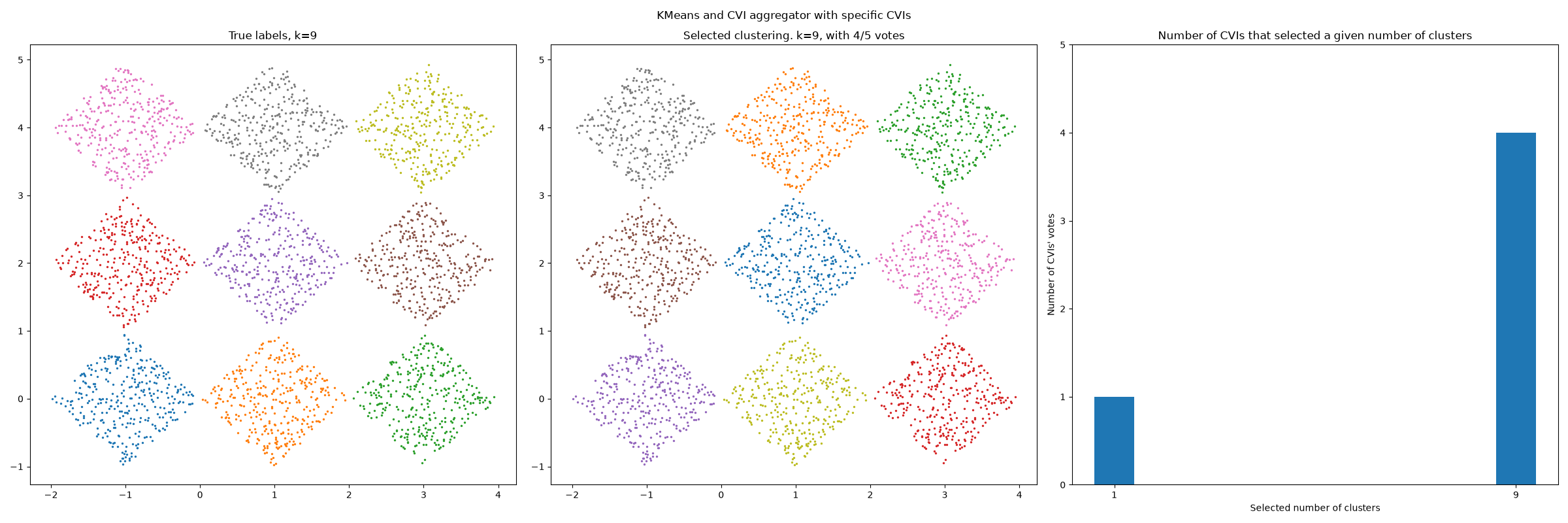
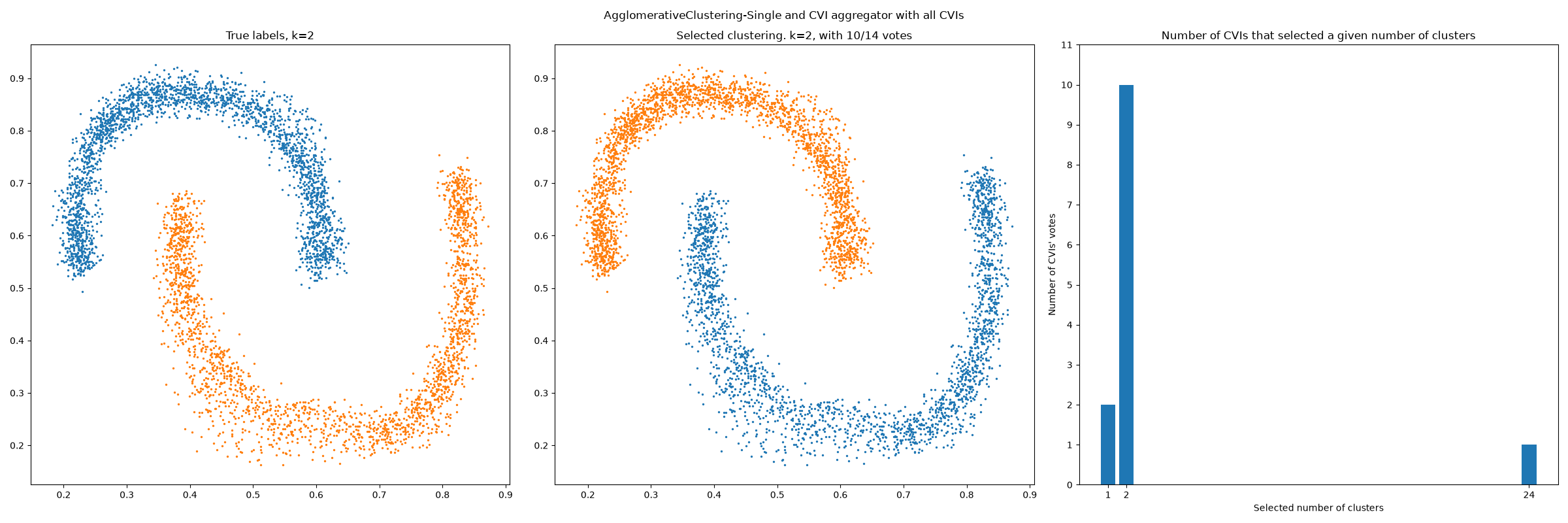
 ***** KMeans and CVI aggregator with specific CVIs *****

Clusterings generated in: 6.90s
Code executed in 38.37 s
Selected k: 9 | True k: 9

 ***** AgglomerativeClustering-Single and CVI aggregator with all CVIs *****

Clusterings generated in: 1.70s
Code executed in 80.86 s
Selected k: 2 | True k: 2